

Third-party tracking scripts are disappearing. Browsers block them, regulations restrict them, and users actively avoid them. However, the data your business needs to grow hasn’t disappeared — it’s just waiting to be collected differently. A solid first-party data analytics strategy lets you gather richer insights than third-party cookies ever provided, without the legal risk.
First-party data is information you collect directly from your audience through your own channels. Consequently, it’s more accurate, more compliant, and more valuable than anything a tracking pixel could deliver. Here’s how to build a strategy that works.

What Is First-Party Data (and Why It Matters Now)
First-party data is any information collected directly from people who interact with your business. This includes website analytics, form submissions, purchase history, email engagement, and survey responses. In other words, it’s data that people knowingly share with you through your own platforms.
The distinction matters because regulations like GDPR treat first-party and third-party data very differently. Moreover, as EU businesses switch away from Google Analytics, first-party data strategies have become essential rather than optional.
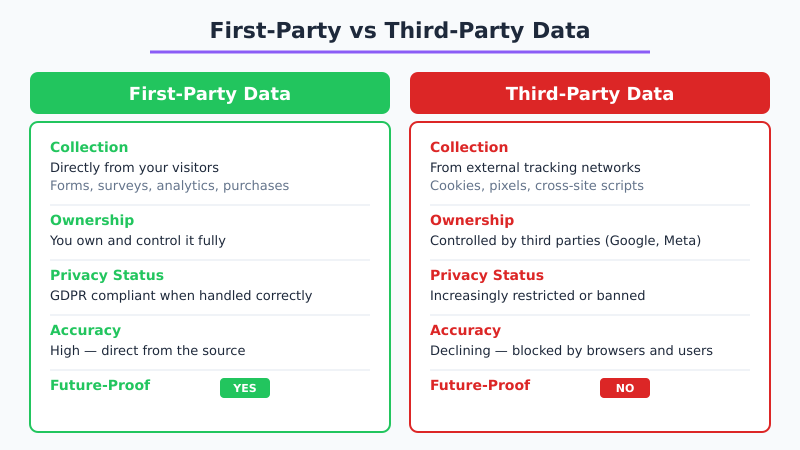
| Attribute | First-Party Data | Third-Party Data |
|---|---|---|
| Source | Your own websites, apps, forms | External tracking networks |
| Consent | Easier to obtain and manage | Requires complex consent flows |
| Accuracy | High — direct from users | Declining — blocked by 40%+ of users |
| Cost | Low ongoing cost | Expensive data broker fees |
| Regulation Risk | Low when handled properly | High — increasingly banned |
| Shelf Life | Long — you control retention | Short — cookies expire, rules change |
“Companies that invest in first-party data strategies see 2-3x improvement in data quality compared to those relying on third-party tracking.” — This isn’t surprising when you consider that first-party data doesn’t suffer from ad blocker gaps or consent rejection.
Six Methods to Collect First-Party Data Without Tracking Scripts
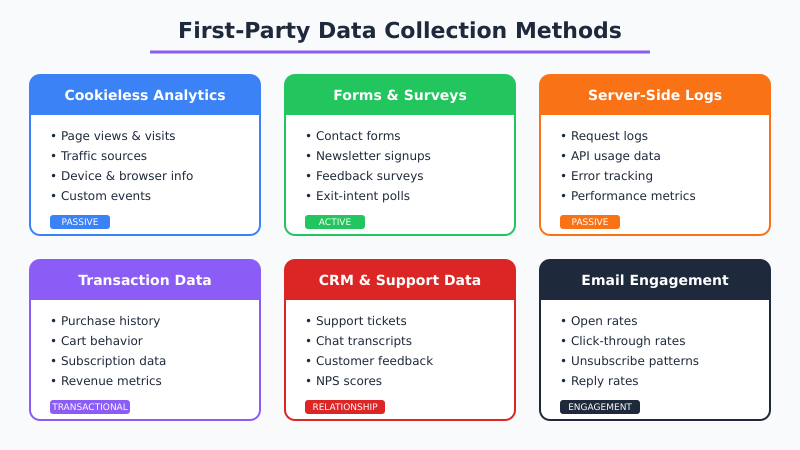
You don’t need invasive JavaScript trackers to understand your audience. In fact, the most valuable customer insights come from methods that don’t involve tracking scripts at all. Therefore, consider these six approaches as the foundation of your first-party data analytics strategy.
1. Cookieless Website Analytics
Privacy-first analytics tools like Plausible, Fathom, and Simple Analytics collect website data without cookies or personal tracking. They give you traffic volumes, sources, top pages, and conversion data while remaining fully GDPR compliant.
Additionally, because these tools don’t require cookie consent, you capture data from 100% of visitors — not just the 40-70% who click “Accept” on a consent banner. As a result, your analytics become more accurate, not less.
2. Forms and Surveys
Direct questions get direct answers. Strategically placed forms and surveys collect exactly the information you need:
- Contact forms: Capture intent, industry, and company size
- Newsletter signups: Track interest topics and acquisition channels
- Post-purchase surveys: Learn why customers bought and how they found you
- Exit-intent polls: Understand why visitors leave without converting
- On-page feedback widgets: Collect real-time content quality signals
The key is asking the right questions at the right time. Therefore, limit each form to 3-5 fields and only ask for information you’ll actually use.
3. Server-Side Data Collection
Server-side analytics process data on your server rather than in the visitor’s browser. This approach is completely invisible to ad blockers and doesn’t depend on JavaScript execution. Moreover, server logs contain valuable data that most businesses never analyze — request patterns, geographic distribution, and performance metrics.
4. Transaction and Purchase Data
Every purchase, subscription, or account creation gives you rich first-party data. This includes product preferences, purchase frequency, average order value, and customer lifetime patterns. Consequently, e-commerce businesses often have the richest first-party data sets without needing any additional tracking tools.
5. CRM and Support Interactions
Customer support tickets, chat logs, and CRM notes contain qualitative insights that no analytics tool can capture. Therefore, systematically categorizing and analyzing support interactions reveals product issues, feature requests, and customer sentiment trends.
6. Email Engagement Metrics
Your email analytics provide direct engagement signals. Open rates, click patterns, and unsubscribe triggers tell you what your audience cares about. Furthermore, email engagement data is first-party by definition — subscribers opted in and interacted directly with your content.
Building Your First-Party Data Stack
A practical first-party data analytics stack doesn’t need to be complex. However, it does need to be intentional. Here’s a recommended architecture for most businesses:

- Analytics layer: Plausible or Fathom for cookieless website analytics
- Form layer: Privacy-respecting form tools (Tally, Typeform, or self-hosted solutions)
- Email layer: Privacy-focused email platform with first-party tracking
- CRM layer: Self-hosted or EU-based CRM for customer data
- Data warehouse: PostgreSQL or similar for combining data sources
| Stack Layer | Recommended Tools | Data Collected | Privacy Level |
|---|---|---|---|
| Web Analytics | Plausible, Fathom | Traffic, events, conversions | No cookies needed |
| Forms | Tally, Typeform | User responses, preferences | Consent at submission |
| Mailerlite, Buttondown | Opens, clicks, engagement | Opt-in based | |
| CRM | Twenty, EspoCRM | Customer lifecycle data | Relationship-based |
| Integration | n8n, Zapier | Combined insights | Your infrastructure |
Privacy Compliance for First-Party Data
First-party data doesn’t mean “no rules apply.” You still need to handle data responsibly. Nevertheless, compliance is significantly simpler when you control the entire data pipeline.
Essential compliance steps:
- Privacy policy: Clearly state what data you collect, why, and how long you keep it
- Consent where required: Email collection needs opt-in; cookieless analytics may not need consent at all
- Data minimization: Only collect what you actually need and use
- Retention limits: Set and enforce data retention periods
- Access controls: Limit who can access personal data within your organization
- Right to deletion: Build processes for handling data deletion requests
Under GDPR, the lawful basis for processing first-party data is often “legitimate interest” rather than “consent” — especially for aggregated, cookieless analytics. However, always consult legal counsel for your specific situation.
Turning First-Party Data Into Actionable Insights
Collecting data is only valuable if you turn it into decisions. Therefore, build a simple analysis workflow:
- Weekly: Review web analytics dashboard for traffic trends and top content
- Bi-weekly: Analyze form submissions and survey responses for patterns
- Monthly: Combine email engagement with web analytics to identify content gaps
- Quarterly: Deep-dive into customer lifecycle data from CRM and transactions
The most powerful insights come from combining data sources. For example, matching your top-performing blog posts (from analytics) with newsletter click patterns (from email) reveals exactly which topics drive the most engaged audience. Similarly, correlating conversion rate data with traffic sources shows where to focus acquisition efforts.
Common First-Party Data Mistakes
Even with the right tools, teams make preventable errors when building their first-party data strategy:
- Collecting everything: More data creates more liability. Collect only what drives decisions.
- Siloed data: Analytics in one tool, forms in another, email in a third — with no connection between them. Therefore, plan your integration layer from the start.
- Ignoring data hygiene: Duplicate records, outdated entries, and inconsistent formats degrade data quality over time.
- No documentation: When team members leave, undocumented data pipelines become black boxes.
- Over-relying on one method: A mix of passive (analytics) and active (surveys) collection gives the most complete picture.
The Competitive Advantage of First-Party Data
Organizations that build strong first-party data analytics capabilities gain a lasting competitive edge. While competitors scramble to adapt each time a browser drops cookie support or a regulation tightens, your data pipeline keeps flowing uninterrupted.
Moreover, first-party data gets better over time. As you refine your collection methods and build historical baselines, your insights become more accurate and actionable. Third-party data, by contrast, gets worse with every new privacy restriction.
Start with cookieless analytics and one additional first-party data source. Consequently, you’ll have a functional first-party data strategy within weeks — not months. Then expand as your needs grow, adding surveys, automated data exports, and combined dashboards. The businesses that make this transition now will be the ones best positioned when third-party tracking finally disappears entirely.